Quick answer
One full-length photo. Three ratios, on your device.
Upload one full-length photo and the body shape detector finds your shoulder, waist and hip points on your device, then measures three ratios: shoulder to hip, waist to hip and waist to shoulder. It names the nearest of five silhouettes (hourglass, rectangle, pear, inverted triangle or apple) and shows your three ratios with clothing rules for that silhouette. The photo never leaves your device.
Upload a full-length photoUpload a photo
Use the upload panel at the top of this page. A phone photo, taken by someone else or on a timer, is enough.
What makes a good photo
- Get your whole body in frame, from the top of your head to your feet.
- Stand straight and face the camera, with your shoulders level.
- Hold your arms slightly away from your sides, so they don't merge with your waist.
- Wear fitted clothing. Loose layers cover your waistline and change the ratios.
- Use even light and, if you can, a plain background.
Each point protects a measurement: a turned body narrows your shoulders, and arms pressed to your sides widen your waist.
Guests get 2 free reads a day; a free account gets 5 a month.
How the body shape detector works
The detector turns your photo into three width ratios on your device and shows you the closest of five silhouettes, in four steps.
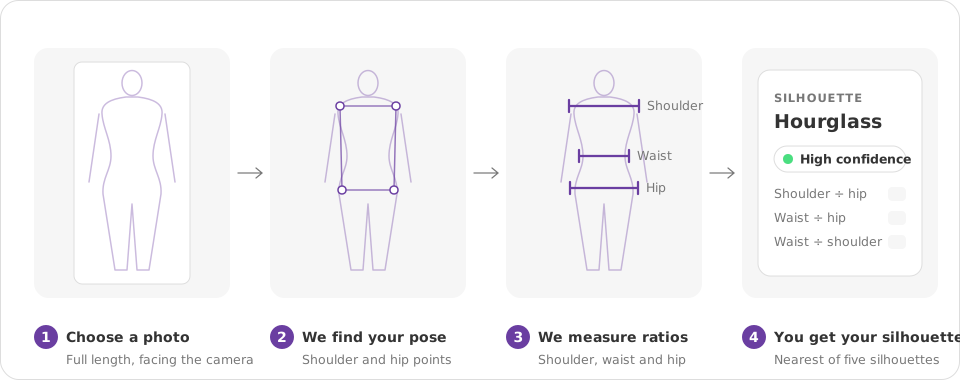
Choose a photo
Use a full-length photo, standing straight and facing the camera, in fitted clothing. You don't need to crop it.
We find your pose
Shoulder, waist and hip points are located on your device; the photo isn't uploaded. MediaPipe Pose places these points in three dimensions, so a slight camera angle matters less than it would on a flat outline.
We measure ratios
Shoulder to hip, waist to hip and waist to shoulder are measured as ratios, not centimetres:
- Shoulder widthRuns between pose landmarks 11 and 12, your shoulder points.
- Hip widthRuns between landmarks 23 and 24, at the hip joints. The joints sit inside the outer line of your hips, so the distance is multiplied by 1.52 to match the width you see.
- Waist widthComes from an outline of your body (MediaPipe Selfie Segmenter): the narrowest part of your torso on a line 58% of the way from shoulders to hips, with your arms left out.
Dividing one width by another cancels out photo size and camera distance.
You get your silhouette
You see your silhouette family, the three ratios, and what to wear for it, with a confidence label and its reason.
The five body silhouettes
Each of the five silhouettes is defined by reference ratios, shown here with what they mean in plain words.
| Silhouette | Shoulder ÷ hip | Waist ÷ hip | Waist ÷ shoulder | In plain words |
|---|---|---|---|---|
| Hourglass | ≈ 1.00 | ≈ 0.72 | ≈ 0.72 | Shoulders and hips about even, clearly narrower waist |
| Rectangle | ≈ 1.00 | ≈ 0.85 | ≈ 0.85 | Shoulders and hips about even, little waist definition |
| Pear | ≈ 0.85 | ≈ 0.70 | ≈ 0.82 | Hips wider than shoulders, narrower waist |
| Inverted triangle | ≈ 1.18 | — | ≈ 0.68 | Shoulders wider than hips |
| Apple | — | ≥ 0.90 | ≥ 0.90 | Waist close to hip and shoulder width |
These are reference points, not pass marks: your result is the closest one. No silhouette is a target or better than another.
Hourglass
Your shoulders and hips are close to the same width, and your waist is clearly narrower than both. The rules keep the waist visible: tailored wrap dresses, high-waisted wide trousers and belted trench coats all mark it. The rule to skip: "Skip oversized, unbelted shapes — they lose the waist definition that gives the silhouette its line."
Rectangle
Your shoulders and hips are close to the same width, and your waist is only a little narrower, so the line from shoulder to hip runs fairly straight. The rules add a waistline: belted blazers to create waist definition, A-line skirts and fit-and-flare dresses, and scoop and sweetheart necklines. The rule to skip: "Skip strictly square, boxy cuts — they repeat the straight line from shoulder to hip."
Pear
Your hips are the widest point, your shoulders are narrower, and your waist is narrower again. The rules bring width and detail to the upper half: structured shoulder jackets and boat necklines, statement collars and puff sleeves, and A-line and flowy dark-wash bottoms. The rule to skip: "Skip flounces at the hip — they add volume to the lower half instead of balancing it."
Inverted triangle
Your shoulders are wider than your hips. The rules move volume below the waist and draw the eye inward at the neckline: wide-leg and flared palazzo trousers, deep V-neck and scoop necklines, and pleated and A-line skirts with volume. The rule to skip: "Skip exaggerated shoulder pads — they widen a shoulder line that already leads."
Apple
Your waist is close to the width of your hips and shoulders, so the middle of your torso sets the outline. The rules favour vertical lines and fabric that skims the middle: empire waist dresses, flowing tunic tops with vertical V-necks, single-breasted open tailored coats and straight-leg pants. The rule to skip: "Skip tight belts across the mid-torso — they draw a horizontal line through the centre of the frame."
Reading your result: ratios, confidence and in-between reads
Your result shows your silhouette, your three ratios to two decimal places, and a confidence label (High confidence, Medium confidence or Lower confidence) with the reason that set it.
- High confidence
- Medium confidence
- Lower confidence
The label weighs how clearly the photo shows you (cropped feet, a sideways stance, tilted shoulders) and how far your ratios sit from the next-closest silhouette. When the photo is the issue, you also get tips, such as stepping back so your whole body fits.
Lower confidence means the photo held the read back, not that something went wrong. You still see the result, with the reasons stated, and a straight-on photo in fitted clothing usually firms it up.
If your ratios sit between two silhouettes, the reason names both; compare your numbers with the silhouette table to see which way you lean. If your proportions sit beyond every reference silhouette, you get the closest one, marked as approximate, and your profile shows the read as extrapolated.
Your photo stays on your device
Your pose is found on your device and the photo is never uploaded. Only the three ratios and a short photo-quality summary are sent, to save your result to your profile, and you can export or delete them at any time.
This is stricter than our face tools, which send the photo once to check its quality. Here, the pose points, body outline and ratios are all worked out in your browser, so there is no photo on our side to store.
Our methodology and privacy policy set out what each tool keeps.
How we check the method
The silhouette prototypes are fixed numbers, so the same three ratios always give the same result. To check that, we keep 1,000 cached full-length pose sets from the Fashionpedia and VITON-HD collections. Their labels were assigned by the same nearest-centroid rules (re-assigned on 27 October 2026 after the rules changed), and re-running the rules reproduces all 1,000 (macro F1 1.000; 95% Wilson interval on the agreement rate 99.62%–100.00%). Researchers and journalists can request access to the scripts and cached data through our contact page; the photos are not redistributed. The check runs with:
pnpm tsx packages/inference/scripts/benchmark-body-1000.tsBecause the labels came from the rules themselves, this shows the method is deterministic and reproducible, not how often a person would agree with a label. A check whose labels come from the classifier itself can show consistency, never accuracy.
The full approach is on how we check our method.
What to wear next
Your clothing suggestions are rules about the shape of a garment: where a neckline sits, whether a waist is marked, where a piece adds volume. They describe the clothes, never the person. On your profile, they are ranked for your silhouette, the occasion and the climate.
For a pear silhouette, "Structured shoulder jackets & boat necklines" add width at the shoulder line to echo the hips. For an inverted triangle, "Wide-leg & flared palazzo trousers" add volume below the hip to echo the shoulders. You pick the pieces that fit what you wear.
Colour is the other half of an outfit: the skin tone detector finds the shades that suit you.
Frequently asked questions
Is the body shape detector free?
Yes. Guests get 2 free reads a day; a free account gets 5 a month. The photo is never uploaded; only the three ratios are sent, to save your result.
Is my photo uploaded?
No. The body shape detector finds your pose on your device. Only the three ratios are sent to save your result; the photo itself never leaves your phone or computer.
Why ratios instead of measurements?
A photo can't give reliable centimetres, but it can compare widths to each other. Ratios of shoulder, waist and hip are what decide a silhouette, so that is what the detector measures.
What should I wear for the photo?
Fitted clothing, standing straight with your arms slightly away from your body and your whole body in frame. Loose clothes cover your waist and change the ratios.
What if my ratios fall between two silhouettes?
You get the closest silhouette together with your three ratios, so you can see how near the boundary you are, and the confidence reason names both silhouettes. On your profile, a read that falls outside every reference silhouette is marked as extrapolated.
How reliable is the result?
Every result comes with a confidence label based on the quality of your photo and how close the next silhouette was. We don't publish a single accuracy percentage, because it would depend on photos we haven't seen and no independently labelled set of body photos exists yet to measure one honestly.
Is body shape the same as face shape?
No. They are different measurements from different tools. Body silhouettes use shoulder, waist and hip ratios from a full-length photo; face shape uses forehead, cheekbone and jaw widths with face length. A pear body has hips wider than shoulders, while a pear (triangle) face has a jaw wider than the forehead. For your face, use the face shape detector.