Face Shape Statistics
Anonymized FaceAuraAI scan counts by labeled shape, with stated selection biases — not a census of faces.
No production count is published yet. This page sets out what we will publish, the biases any count will carry, and how to cite it.
Quick answer
No percentages until they can be honest.
FaceAuraAI hasn't published face shape percentages yet, because it publishes counts only with a documented sample window, a sample size and stated selection biases. Figures on other sites disagree because they use different shape lists, different rules and self-selected users. None of them is a census of faces, and ours won't be either.
See how results are checkedWhat we will publish
Each release will be a dated set of counts, stating:
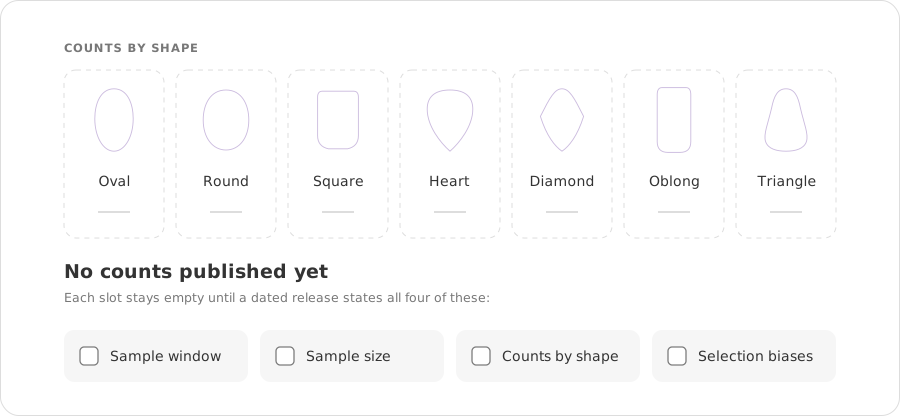
- Sample windowThe first and last dates of the reads counted.
- Sample sizeThe number of completed reads in that window.
- Counts by shapeOne for each of the seven labelled shapes: oval, round, square, heart, diamond, oblong and triangle.
- Confidence mixThe share of reads labelled High confidence, Medium confidence and Lower confidence.
- Processing pathHow many reads had landmarks found in the browser, and how many on our server.
- Method versionThe classifier version behind the labels.
- Declared splits, if anyOnly by an audience people stated themselves, never inferred from a photo.
This page's last-updated date changes only when a release or the policy changes.
Why face shape statistics differ between sites
Face shape figures disagree because each site counts something different:
- The shape listSome systems use six families, others eight or more; FaceAuraAI uses seven. A face one list calls pear is triangle on ours.
- The labelling methodPhoto landmarks, tape measurements and quiz answers can label the same face differently, because each has its own reference numbers. What is my face shape compares them.
- Who took partPeople who use a face shape tool chose to; they are not a random sample.
- How blends are countedA face between two shapes counts once, and the rule that picks its label moves the totals.
- Repeat scansOne person scanning several photos counts several times unless reads are deduplicated.
- Photo quality filteringSome counts drop unclear photos; others keep every result.
Before you trust any face shape statistic, look for the sample window, the sample size, the shape list and how blends were counted.
Stated selection biases
Any count FaceAuraAI publishes will carry these biases:
- Self-selected uploadersOnly people who choose a FaceAuraAI tool and upload their own photo appear.
- Front-facing, readable photosA read counts only when landmarks can be found; a photo with no face detected never becomes a label.
- Two processing pathsLandmarks are found in your browser where possible, and otherwise on our server (currently by Amazon Rekognition).
- English-first trafficMost visitors arrive through English-language pages.
- No stratified samplingCounts are not balanced by age, region, skin tone or declared audience unless a release says so.
- Repeat readsThe same person can scan more than once; each release states its deduplication rule.
How a label gets counted
One completed read adds one label: the primary shape, with its confidence label recorded beside it. Labels come from the same geometric classifier as the face shape detector, and no person reviews them.
A face between two shapes counts once, under its primary shape; the blend rate will be reported separately.
When no rule scores at all, the classifier returns oval with Lower confidence, which is one reason every count will carry its confidence mix. How FaceAuraAI works sets out the rules; quality and evaluation explains confidence and known limits.
How published counts stay honest
- Never drawn from test sets, regression photos or drift reports, which are engineering tools.
- Never presented as a census, or as how common a shape is in the population.
- Never converted from per-read confidence into an accuracy figure.
- Every number dated, with its sample window and biases beside it.
Cite this page
Until counts are published, cite this page for the publishing policy and selection biases only.
FaceAuraAI. "Face Shape Statistics." https://faceauraai.com/data/face-shape-statistics. Accessed [date].
For a product description and a media contact, use the press kit.
Frequently asked questions
What is the most common face shape?
FaceAuraAI hasn't published shape counts, so we don't name one. Other sites' answers depend on their shape list, rules and users, which is why they disagree. Ours will come with a sample window and stated biases. To check your own shape, use the face shape detector.
What is the rarest face shape?
We haven't published counts, so we won't guess. A shape that looks rare in one tool's results may reflect its shape list, rules or users rather than faces in general. Our counts, when published, still won't be a census.
Are the 1,003 benchmark portraits a statistic about face shapes?
No. They are a test set, filled to a fixed quota of 150 photos per shape (103 for oblong) to check that the rules return the same label every time. Because the quota was fixed, the set says nothing about how common any shape is. Quality and evaluation explains the check.
Why not show millions of scans?
We publish only counts we can document with a sample window and stated biases. Inflated social proof breaks FaceAuraAI's claims policy. Older blog posts may quote cohort sizes; they are not dataset releases, so please don't cite them.
Will this page update?
Yes. When FaceAuraAI releases anonymised production counts, they will appear here with their sample window, sample size and bias notes. The last-updated date changes only when a release or the policy changes.
How should editors attribute FaceAuraAI?
Link to this page and name the source: FaceAuraAI. "Face Shape Statistics." https://faceauraai.com/data/face-shape-statistics. Accessed [date]. Until counts are published, cite it for the policy and biases only; afterwards, include the sample window of the release you quote.