Quality & Evaluation
FaceAuraAI gives each result a confidence label from photo quality and how clear-cut the result was — not a public accuracy percentage or census claim.
Quick answer
A confidence label on every result. No accuracy claims.
Each result carries a confidence label (High, Medium or Lower) based on that photo's quality and how clear-cut the result was. FaceAuraAI publishes no accuracy percentage, because no independently labelled photo set exists yet to measure one honestly. It publishes the rules, a script showing they are deterministic, and the conditions where results are less reliable.
Read the rulesCalibrated confidence language
Every face shape result is labelled High confidence, Medium confidence or Lower confidence. It describes that one photo, not how often the tool is right.
Four signals set it: lighting and sharpness, head angle, how many landmarks were measured rather than estimated, and how close the next shape scored. Reasons appear in plain words, such as "the closest alternative was a near-tie"; a close runner-up is named too.
Lower confidence means the photo held the read back, not that something went wrong. You still see the result with its reasons, and a straight-on photo in even light usually firms it up. It is never shown in red: "No face detected" is an error, not a result.
A photo whose lighting and sharpness can't be measured is flagged and never labelled High confidence. The number the face shape detector shows beside the label reflects how strongly your measurements matched the winning shape's rules, not an accuracy figure.
Known limits
| What affects it | Why | What helps |
|---|---|---|
| Lighting | Uneven or coloured light shifts both the landmarks and the measured skin colour. | Face a window in daylight. |
| Head angle | Turning or tilting your head moves every landmark on one side, which changes widths and reads as asymmetry that isn't there. | Look straight at the camera, head level. |
| Hair | Hair over your forehead, temples or jaw hides the points that decide face shape. | Pull your hair back for the read. |
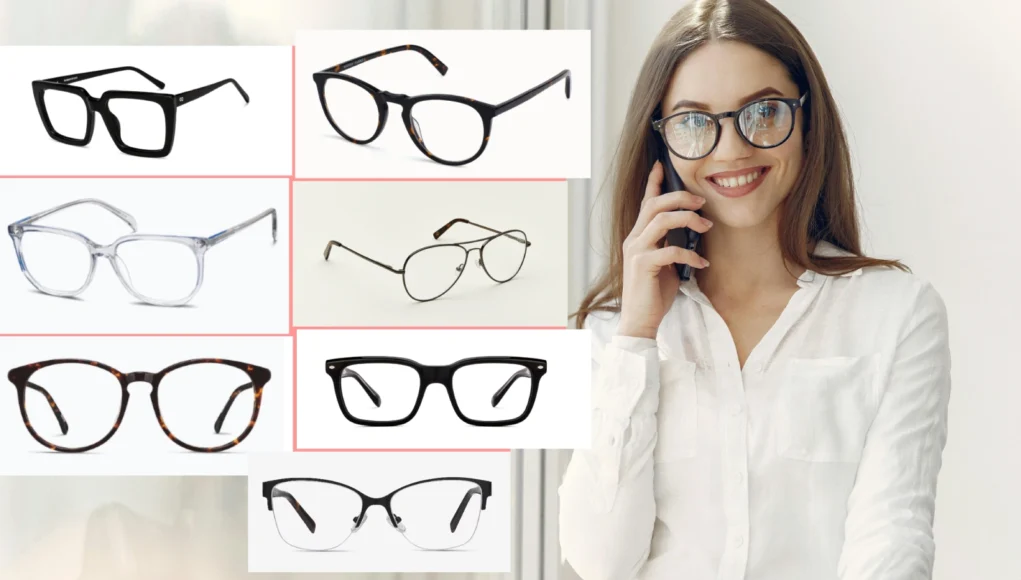
| Glasses | Frames cover the brow and cheekbone landmarks and change eye measurements. | Take your glasses off. |
| Makeup and filters | Foundation, bronzer and beauty filters change the measured skin colour; heavy contouring can shift perceived edges. | Use an unfiltered photo, ideally with little makeup, for colour. |
| Expression | Smiling widens the mouth and lifts the cheeks; squinting changes eye measurements. | Keep a relaxed, neutral expression. |
Who the results are drawn from
Results, and any count we publish, inherit these biases.
- Self-selected uploadersPeople who choose to upload a selfie, not a random sample of faces.
- Photos that passOnly front-facing photos with enough landmarks found reach a result.
- Two processing pathsLandmarks are found in your browser first, or on our server when your browser can't (currently by Amazon Rekognition).
- LanguageMostly English-language traffic, with five other languages at lower volumes.
- No stratificationNothing is sampled by age, skin tone or declared audience unless a published count says so.
- A quota-filled check setThe 1,003 check portraits came from FairFace and CelebA-HQ, filled to a fixed quota per shape, so they show nothing about how common a shape is.
How we check the method
Every change is checked against fixed test photos
Every change to how faces are measured is checked against a fixed set of test photos and ships only if each photo's shape, confidence, scores and measurements stay the same, unless intended. The set checks consistency, not accuracy, and its size isn't published.
The 1,003-portrait rule-consistency check
The public check uses 1,003 single-subject, front-facing portraits from the FairFace and CelebA-HQ validation sets, each with a near-frontal head pose and a complete, unobscured landmark mesh.
Re-run on the cached landmarks, the rules return the label every portrait was filed under. The agreement rate, the share of photos given the same label again, is 1,003/1,003. Macro F1, a per-shape agreement score averaged evenly across the seven shapes, is 1.000. The 95% Wilson interval on the agreement rate, the range the underlying rate plausibly sits in given 1,003 photos, is 99.62%–100.00%; its lower end reflects sample size, not a disagreement.
Because those labels were first assigned by these rules, this shows the method is deterministic and reproducible, not how often a person would agree.
A 1,000-photo body set does the same for body shape: its labels were re-assigned by the current nearest-centroid rules on 27 October 2026, and a re-run reproduces all 1,000 (macro F1 1.000; 95% Wilson interval 99.62%–100.00%).
pnpm tsx packages/inference/scripts/benchmark-1000.ts
pnpm tsx packages/inference/scripts/benchmark-body-1000.ts
Researchers and journalists can request access to both scripts and their cached landmarks through our contact page; the rules are set out in full under re-run our rule check.
What these checks can't tell us
The 1,003 photos were filed under the shapes these rules gave them, so a re-run tests the rules against their own earlier answers. It's like marking your own exam with your own answer key: it shows you're consistent, not that you're right. It can't reveal a misclassification, a difference between groups of people, or a threshold in the wrong place.
Measuring accuracy needs photos labelled independently by people, across ages, skin tones and lighting. Until FaceAuraAI has such a set, it publishes no accuracy figure.
How published counts stay honest
FaceAuraAI publishes shape counts from real scans on face shape statistics only under these conditions, and none has been published yet.
- Each count needs a documented sample window, its sample size and its stated biases.
- Counts never come from test sets, regression photos or drift reports.
- A count describes the people who used the tool, never all faces.
- Confidence is never converted into an accuracy figure.
What journalists can cite
Cite this page and how FaceAuraAI works for the method, confidence labels and known limits. Please don't quote scan totals or accuracy rates: we haven't published any. Media assets are in the press kit.
Frequently asked questions
Is confidence the same as accuracy?
No. Confidence says how much to trust one read, based on that photo's quality and how clear-cut the result was. It is not an accuracy percentage, and we don't publish one.
Why don't you show an accuracy percentage?
A headline accuracy figure would depend on photos we haven't seen and would overstate what one number can tell you about your own photo. Measuring it honestly needs independently labelled photos, and no such set exists yet.
Your check scored 1,003 out of 1,003. Why isn't that accuracy?
The labels in that set were first assigned by the rules being checked, so a perfect score shows the rules are deterministic and the script reproducible, not that a person would agree. Accuracy needs independently labelled photos.
Can I re-run the check myself?
Yes. Researchers and journalists can request access to the code repository through our contact page, then run pnpm tsx packages/inference/scripts/benchmark-1000.ts from its root; the cached landmarks are included, and the source photos aren't redistributed.
Does the detector work equally well for every skin tone and age?
We can't show that yet. Some check photos came from FairFace, built to span seven demographic groups and many ages, but they were picked by shape and labelled by the rules themselves, so group differences can't be measured. Lighting affects landmarks on every face.
How do you keep results consistent over time?
Every change to how faces are measured is checked against fixed test photos and ships only if their results stay the same, unless intended. So the same photo keeps giving the same read.
What can journalists cite?
This page and the methodology page, for how FaceAuraAI works and its limits. Please don't quote scan totals or accuracy rates: we haven't published any.