It compares the same families of ratio (your face length, forehead width and jaw width, each against your cheekbone width), with its own reference patterns for tape measurements. Four numbers can't show the angle of your jaw or chin, so its result can differ from a photo read.
Quick answer
Four measurements. Your closest shape.
Measure your forehead, cheekbones and jaw straight across and your face from hairline to chin, in any unit, and type the four numbers. The calculator divides each by your cheekbone width, compares the three ratios with seven typical face-shape patterns, and shows the closest one, a fit label, and a second shape when you sit between two. Nothing is uploaded.
Enter your measurementsEnter your measurements
Use any unit; only the ratios matter. The example buttons, Example Oval to Example Triangle, fill in sample numbers to show how each pattern reads. The Use a photo tab sends you to the face shape detector, which measures from a selfie, angles included.
What your result shows
- Your likely shape: the pattern your numbers sit closest to.
- Fit: High, Medium or Lower: how clearly your numbers point to this shape rather than another. They're your own measurements, so if the result surprises you, measure again.
- Your three ratios (length ÷ width, forehead ÷ cheek, jaw ÷ cheek) to two decimals, to check against the table below.
- Also close: a second shape whose pattern is nearly as close, with a link to its guide, or "No other shape is close for these measurements."
- Next steps: your shape's guide, and "Check with a photo".
It is a styling estimate from geometric rules, not a medical or identity label.
How to measure your face
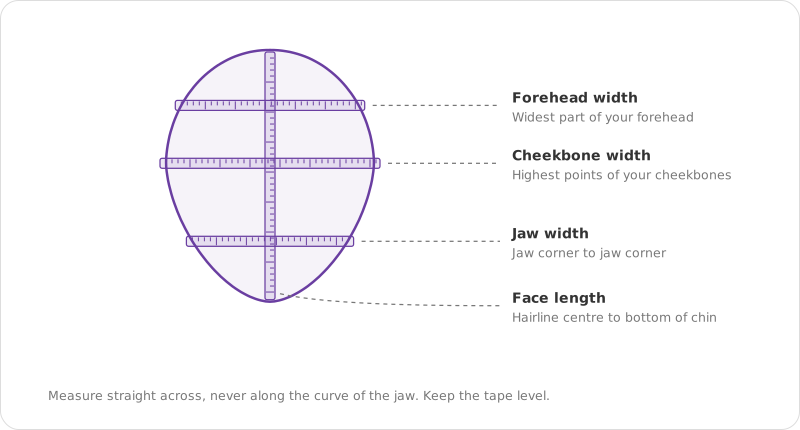
You need a soft tape (or string and a ruler) and a mirror. Pull your hair back off your forehead and ears, keep your head level, and use one unit throughout.
Forehead width
Measure straight across your forehead at its widest point, usually about halfway between your eyebrows and your hairline.
Cheekbone width
Find the highest point of each cheekbone, just below the outer corner of each eye, and measure straight across between them.
Jaw width
Find the corner of your jaw below each ear — where the jaw turns towards the chin — and measure straight across between the two corners.
Face length
Measure from the centre of your hairline straight down to the bottom of your chin. If your hairline is receding, start where it used to be.
Measuring tips
- Measure straight across, never along the curve of your jaw. The curve gives a much larger number.
- Keep the tape level and don't press into the skin.
- Measure twice and type the average if the readings differ.
How the calculator works
Three steps, each repeatable by hand:
- Three ratios. It divides your face length, forehead width and jaw width each by your cheekbone width. The unit cancels out.
- Seven patterns. Each shape has a typical pattern of those three ratios for tape measurements (table below).
- Nearest pattern. It measures how far your ratios sit from each pattern, allowing more room on length (±0.16) than on widths (±0.08), and names the closest, plus a second shape if it is nearly as close.
These are the same families of ratio the photo detector compares, but not the same rules. The detector also scores the angle of your jaw corners and chin, which a tape can't capture, and measures length from a lower starting point. So the calculator has its own reference numbers, and the two tools can name different shapes for the same face.
The calculator also checks plausibility: if a ratio is far outside any face, usually from mixed units or a typo, it asks you to check your numbers.
Ratio patterns for all seven shapes
These are typical tape-measure patterns, not cut-offs: your numbers won't sit on a row, and the closest row wins.
| Shape | Length ÷ cheekbone width | Forehead ÷ cheekbone | Jaw ÷ cheekbone | In words |
|---|---|---|---|---|
| Oval | 1.35 | 0.90 | 0.80 | Clearly longer than wide; cheekbones widest; forehead a little wider than jaw |
| Round | 1.02 | 0.92 | 0.88 | About as long as wide; widths close together |
| Square | 1.08 | 0.98 | 0.98 | About as long as wide; forehead, cheekbones and jaw nearly equal |
| Heart | 1.28 | 1.02 | 0.72 | Forehead widest; jaw clearly narrower |
| Diamond | 1.32 | 0.78 | 0.74 | Cheekbones widest; forehead and jaw both narrower |
| Oblong (rectangle) | 1.55 | 0.96 | 0.94 | Noticeably longer than wide; all three widths close |
| Triangle (pear) | 1.22 | 0.80 | 1.04 | Jaw widest; forehead narrower |
Tolerances: length ±0.16, widths ±0.08.
Worked example: Example Oval (length 19, forehead 13.5, cheekbones 15, jaw 12) gives 1.27, 0.90 and 0.80. Oval is nearest, with a High fit because the next pattern, diamond, is well behind.
Why these numbers differ from the photo detector's
The photo detector measures face length from the top of its forehead outline, which usually sits below your hairline, so its length ratios run lower than a tape's. It also scores the angles of your jaw and chin. Don't compare your tape ratios with the detector's published rules; each tool has its own. See how the photo rules work.
Calculator, photo detector or quiz?
All three name one of the same seven shapes from different evidence.
| Tool | What you give it | Measures jaw and chin angles? | Repeatable? | Uploads anything? | Best for |
|---|---|---|---|---|---|
| Calculator (this page) | Four tape measurements | No | As steady as your measuring | No | No camera, or you like to measure |
| Photo detector | One front-facing photo | Yes | Yes: the same photo gives the same result | Yes, once, for quality checks; never stored | The most repeatable read, with a confidence label |
| Face shape quiz | Six questions | Self-described | Less: answers are judgement calls | No | A quick first guess |
Check with a photo: it measures the angles four numbers can't.
Frequently asked questions
Do I need centimetres or inches?
Either. The calculator divides three measurements by your cheekbone width, so the unit cancels out. Use one unit for all four; mixing centimetres and inches is the usual cause of an odd result.
How do I measure my jaw width?
Find the corner of your jaw below each ear, where the jaw turns towards the chin, and measure straight across between the two corners. Don't measure along the curve of the jawline, which gives a much larger number.
Is anything I enter sent or stored?
No. Nothing is uploaded; you type four numbers. The calculation runs in your browser, and the numbers you enter aren't sent to FaceAuraAI or stored.
What does the fit score mean?
Fit shows how clearly your four numbers point to one shape's pattern rather than another, labelled High, Medium or Lower. It is not an accuracy figure. A Lower fit usually means your ratios sit between two patterns or a measurement is off: measure again or check with a photo.
Why does my result show two shapes?
Your ratios sit nearly as close to a second pattern as to the first, so the calculator names both. Read both guides, because advice for neighbouring shapes overlaps. Between round and square? The round vs square comparison shows what separates them.
Why might the calculator and the photo detector disagree?
They compare the same families of ratio against different reference numbers. The detector also measures your jaw and chin angles, and measures length from a point that usually sits below your hairline. Neither tool is broken. Read both shapes, and use a straight-on photo in even light for the steadier read.
Why does it say my numbers don't look like a face?
At least one ratio falls far outside any real face, usually because of mixed units or a mis-typed number. Check that all four use one unit and that each width was measured straight across.
Calculator or photo: which is more repeatable?
The photo. The detector measures landmarks the same way every time, so the same photo gives the same result, and it counts the jaw and chin angles. The calculator is as repeatable as your measuring: a small shift in tape placement can change the result.
Face shapes