The Seven Face Shapes
There are seven common face-shape families — oval, round, square, heart, diamond, oblong (rectangle), and triangle (pear) — defined by the relative widths of forehead, cheekbones, and jaw.
Quick answer
Seven shapes, four measurements.
There are seven face shapes: oval, round, square, heart, diamond, oblong (rectangle) and triangle (pear). Four measurements place your face among them: forehead width, cheekbone width, jaw width and face length. Which width is largest, how long your face is against its width, and whether your jaw has corners decide the shape, and many faces sit between two.
Check your shape from a photoHow face shape is measured
Face shape is read from four measurements and two shape cues, with your hair pulled back and your face straight to the camera.
- Forehead widthAcross your forehead at its widest point, about halfway between your eyebrows and hairline.
- Cheekbone widthAcross the highest point of each cheekbone, just below the outer corner of each eye.
- Jaw widthAcross the corners of your jaw below each ear, where the jaw turns towards the chin.
- Face lengthFrom the centre of your hairline down to the bottom of your chin.
- Jaw angleHow sharply your jaw turns at those corners, from a soft curve to a defined corner.
- Chin shapeWhether your chin is broad and flat, rounded, or narrow and pointed.
A photo measures all six; a tape measure captures the four lengths, which is why the two methods use different reference numbers.
The seven face shapes side by side
This chart sets all seven side by side, with the main rule the detector scores each on.
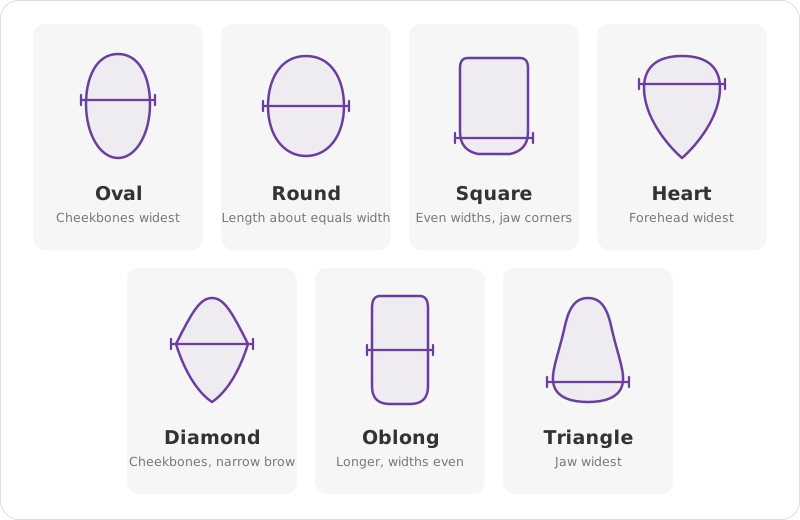
| Shape | Also called | What reads widest | Jaw and chin | Rule the detector scores (photo) | Guide |
|---|---|---|---|---|---|
| Oval | — | Cheekbones; forehead a little wider than jaw | Rounded, no sharp corners | Length ÷ cheekbone width 1.18–1.23; jaw angle ≥ 136° adds points | Oval guide |
| Round | — | Cheeks; length close to width | Soft, curved jaw; rounded chin | Length ÷ cheekbone width ≤ 1.15 and jaw angle ≥ 138°; chin angle 105°–125° adds points | Round guide |
| Square | — | Forehead, cheekbones and jaw close together | Sharp jaw corners; broad chin | Jaw angle ≤ 136.5°; jaw ÷ cheekbone ≥ 0.885 and chin angle ≥ 113° add points | Square guide |
| Heart | — | Forehead and cheekbones; jaw clearly narrower | Narrow, often pointed chin | Chin angle ≤ 100° (strongest); temple ÷ jaw ≥ 1.14 adds points | Heart guide |
| Diamond | — | Cheekbones, clearly; forehead and jaw narrower | Narrow chin | Forehead ÷ cheekbone ≤ 0.71 (shorter face) or ≤ 0.73 (longer face, chin angle ≤ 110°) | Diamond guide |
| Oblong | Rectangle | All three close; face clearly long | Fairly straight sides | Length ÷ cheekbone width ≥ 1.25 and chin angle ≥ 105° | Oblong guide |
| Triangle | Pear | Jaw; forehead narrower | Full, wide jaw | Jaw angle ≥ 144° with forehead ÷ cheekbone ≥ 0.74, or jaw ÷ cheekbone 0.88–0.90 with forehead ≤ 0.69 | Triangle guide |
The detector scores every shape against these rules and the highest score wins, so a face can earn points on two shapes at once.
These are photo numbers. The detector measures length from the top of its forehead outline, which usually sits below your hairline, so a tape measure gives higher length readings; the face shape calculator uses its own reference numbers for that.
To read the rule column: jaw ÷ cheekbone ≥ 0.885 means your jaw is at least 0.885 times as wide as your cheekbones. A wider jaw angle means a softer jaw corner; a wider chin angle means a broader chin, a narrower one a more pointed chin.
The seven shapes in brief
Oval
An oval face is longer than it is wide, with the cheekbones as the widest point, a forehead slightly wider than the jaw, and a jaw that curves into a rounded chin. Styling keeps that balance: most lengths, partings and frame shapes work. Read the oval face shape guide
Round
A round face is about as wide as it is long, with full cheeks, a soft jawline without sharp corners, and a rounded chin. Square shares those proportions but has defined jaw corners. Styling adds height and length: volume at the crown, length below the chin, and angular frames. Read the round face shape guide
Square
A square face is about as wide as it is long, with an angular jaw nearly as wide as the cheekbones and forehead, and a broad, fairly flat chin. Styling softens the angles: layers and movement around the jaw, and rounded or oval frames. Read the square face shape guide
Heart
A heart face is widest across the forehead and cheekbones and tapers to a narrow, often pointed chin. Diamond, by contrast, has a narrow forehead. Styling balances the wider top: fullness at the jaw, and frames wider at the bottom. Read the heart face shape guide
Diamond
A diamond face is widest at the cheekbones, with a noticeably narrower forehead and a narrow jaw and chin. Styling adds width at both ends: fringes, volume at the ends, and frames with a strong top line. Read the diamond face shape guide
Oblong (rectangle)
An oblong face, also called rectangle, is noticeably longer than it is wide, with forehead, cheekbones and jaw close to the same width. Styling adds width and breaks up length: volume at the sides, a fringe, and wide or deep frames. Read the oblong face shape guide
Triangle (pear)
A triangle face, also called pear, is widest through the jaw and narrows towards the forehead, with full jaw corners rather than sharp ones. Square, by contrast, keeps forehead and jaw close to one width. Styling brings width up: volume at the temples and crown, and frames with a strong or upswept top line. Read the triangle face shape guide
Most commonly confused pairs
These five pairs are where most in-between results land. Each comes down to one difference you can check.
- Oval vs oblongLength emphasis versus cheekbone-led width. Oblong keeps forehead, cheek and jaw widths more even, and the detector starts scoring it at 1.25 times cheekbone width, just above oval's 1.23 ceiling, so a 1.24 face scores on neither length band.
- Oval vs diamondForehead and chin width relative to cheekbones. Diamond narrows more at both ends. A low hairline or uneven light can hide forehead width, so pull your hair back before you judge.
- Round vs squareJaw angle and cheek fullness. Same proportions; square has corners. Facial hair can add width and angles at the jaw, so a clean-shaven photo is more repeatable.
- Heart vs diamondWhether the forehead or the cheekbones dominate width. A heart forehead is wide; a diamond forehead is narrow, leaving the cheekbones clearly widest. The detector's diamond rule always needs a narrow forehead.
- Heart vs squareForehead-led taper versus even width. Heart narrows to a pointed chin; square keeps a broad jaw close to cheekbone width. The detector looks for a chin of 100° or tighter for heart, 113° or wider for square.
How the face shape detector estimates shape
From a front-facing photo, the detector maps 468 landmarks and compares your forehead, cheekbone and jaw widths with your face length, plus the angles at your jaw corners and chin. The measurements are normalised, so the size of the photo doesn't change the result.
It then scores all seven shapes against the rules in the chart above. It names the closest shape, and the next-closest when the two are near.
Each result carries a confidence label (High, Medium or Lower) based on lighting, sharpness, head angle, how many landmarks were measured directly, and how close the next shape was. Lower confidence is an honest result, not an error, and a straight-on photo in even light usually firms it up.
Your photo is sent once over an encrypted connection to check its lighting and sharpness. Landmarks are found in your browser first; if your browser can't find them, our server does (our own model, or Amazon Rekognition). The photo is held in memory for that request only, never stored and never used to train models.
Check your face shape with the detector
How we check the method
The rules are deterministic: re-run on 1,003 cached portraits, they reproduce every label. Because those labels were first assigned by the same rules, this shows the method is consistent and re-runnable by anyone, not that a label is right for every face. How FaceAuraAI works sets out the rules, and How we check quality covers the check, the command that runs it and its known limits.
Other ways to find your face shape
Besides a photo, you can find your likely shape three ways.
- Face shape calculator: type in four tape measurements and nothing is uploaded. It compares them with its own tape-measure patterns, not the photo rules in the chart, and it can't see jaw or chin angles.
- What is my face shape?: the step-by-step guide to the mirror, tape and photo methods.
- Face shape quiz: six questions about your length, widest point, forehead, jaw and chin, for a quick first guess without a photo or a tape.
If two methods disagree, read both shape guides; a straight-on photo in even light is the most repeatable read.
Face shapes for men and women
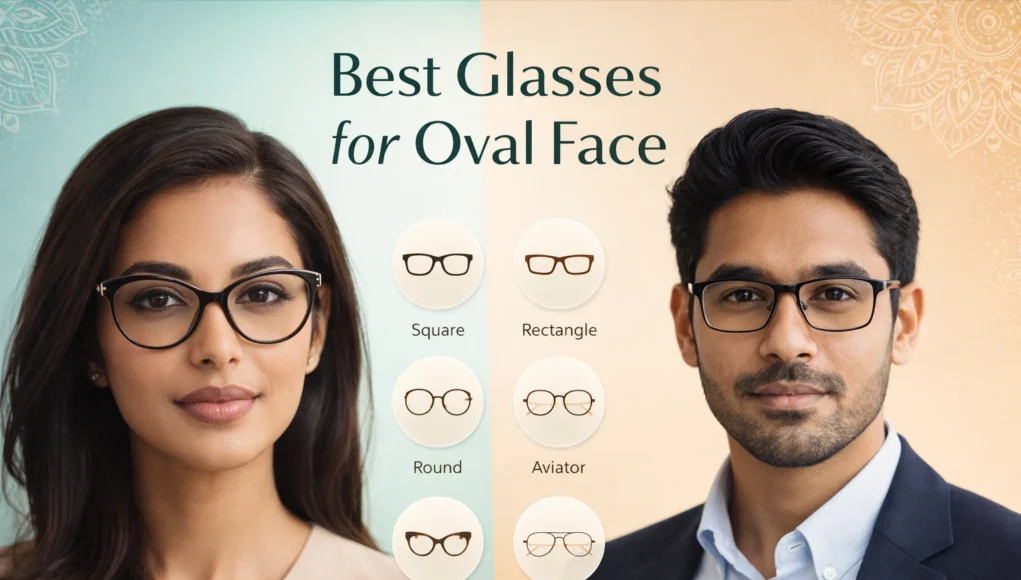
The seven shapes and the rules that score them are the same for everyone; only the styling changes. You choose whether you want men's or women's guidance, and the detector never guesses gender. For haircuts, beards and frames shape by shape, read the men's face shape guide. For frame families, bridge fit and sizing across all seven shapes, see glasses for your face shape.
Frequently asked questions
How many face shapes are there?
There are seven face shapes: oval, round, square, heart, diamond, oblong (also called rectangle) and triangle (also called pear). They are told apart by forehead, cheekbone and jaw widths, face length, and the jaw and chin. FaceAuraAI uses the same seven.
How do I find my face shape?
Compare the widths of your forehead, cheekbones and jaw with your face length, in a straight-on photo with your hair pulled back. The face shape detector measures them for you, jaw and chin angles included. The face shape calculator works from tape measurements you take yourself.
What if my face doesn't match just one shape?
That is common. When your measurements sit near the line between two shapes, the face shape detector names both and shows how close you are to each, so you can use styling ideas from either. Pair pages such as oval vs oblong show the one difference to check.
Is there a best or ideal face shape?
No. No face shape is better than another. Face shapes describe proportions so that haircuts, beards and frames can work with them, and none of the seven is a goal to aim for. Some shapes have fewer styling constraints, which says nothing about how anyone looks.
Which face shape is the most common?
FaceAuraAI doesn't publish shape frequencies yet. We will only publish counts with a documented sample window and stated biases. Figures quoted elsewhere come from different shape lists, rules and users, so they don't compare. Our face shape statistics page explains the publishing policy.
Can my face shape change over time?
Your bone structure doesn't change in adulthood, but weight, age and posture can change where the widest point reads, especially at the cheeks and jaw. A new straight-on photo shows how your shape reads today.
Should I use the detector, the calculator or the quiz?
Use the detector if you have a clear, front-facing photo: it is the most repeatable read and also measures jaw and chin angles. Use the calculator if you would rather measure yourself with a tape. Use the quiz if you want a quick first guess without a photo or a tape.
Are face shapes different for men and women?
No. The seven shapes and the rules that score them are the same for everyone; only the styling differs. You choose men's or women's guidance yourself, and the detector never guesses gender. The men's face shape guide covers haircuts, beards and frames for each shape.