Quick answer
Answer six questions at a mirror about your face length, your widest point, your forehead, your jaw and your chin. The quiz matches your answers to the patterns of the seven face shapes (oval, round, square, heart, diamond, oblong and triangle) and names the closest as your likely shape, plus a second shape when you sit between two. It runs in your browser, needs no photo, and nothing is saved.
How to take the quiz
Set up at a mirror
Stand in even light, facing a mirror straight on. Pull your hair back off your forehead and away from your jaw, take off your glasses, and keep a relaxed, neutral expression.
Answer the six questions
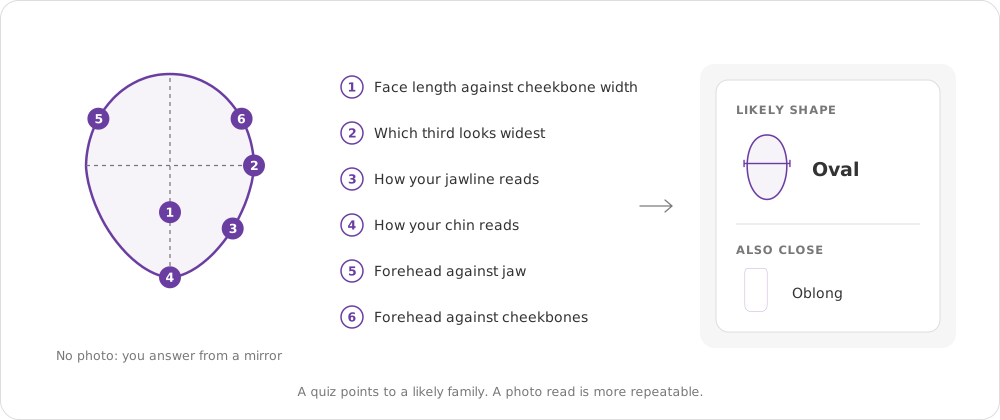
Each question looks at one thing that tells the shapes apart:
- How your face length compares with your cheekbone width: noticeably longer, about the same, or wider than long.
- Which third looks widest: forehead, cheekbones, jaw, or fairly even.
- How your jawline reads: soft and rounded, angular or square, or tapered toward the chin.
- How your chin reads from the front: pointed or narrow, rounded, or broad or flat.
- Your forehead width compared with your jaw width.
- Your forehead width compared with your cheekbone width. This is the question that separates a narrow forehead (diamond, triangle) from a wide one (heart).
Read your likely shape
Your answers are turned into rough width and length proportions and compared with the tape-measure patterns for each shape that the face shape calculator also uses. The closest pattern is your likely shape. When another shape is almost as close, the quiz names it too, because faces between two shapes are common.
Take the quiz
Use the quiz at the top of this page. It asks one question at a time, with a Back button, and shows your likely shape as soon as you answer the last one.
If you are torn between two answers, pick the one that fits a little better. A result that names a second shape is not an error; it tells you the advice for both shapes is worth reading.
Quiz, tape measure or photo
The quiz is the quickest of the three ways to find your face shape, and the least precise, because each answer is a judgement made by eye. A tape measure gives you numbers to compare, and a front-facing photo measures your widths and jaw angle directly. What is my face shape compares all three methods and what each one can't see.
| Method | What you need | What it measures | Best for |
|---|---|---|---|
| Quiz | A mirror | Your own judgement of proportions | A quick first guess |
| Tape measure | A soft tape and a mirror | Four widths and lengths you read off | Checking by hand |
| Photo | One front-facing photo | Landmark widths, length and jaw and chin angles | The most repeatable read |
Confirm it with a photo
A front-facing photo gives a more repeatable answer, because the face shape detector measures your forehead, cheekbone and jaw widths, your face length and your jaw and chin angles from landmarks instead of asking you to judge them. Every photo result carries a confidence label (High, Medium or Lower) with its reason in words. Your photo is sent once for quality checks and never stored.
Check with the face shape detector
Frequently asked questions
How does the face shape quiz work?
Each question asks about one thing that tells the shapes apart: your length against your width, your widest point, your forehead against your cheekbones and against your jaw, and how your jaw and chin look. Your answers are matched to the pattern of each of the seven shapes, and the closest one is your likely shape.
How reliable is the quiz?
It is a good first guess, but your answers are judgement calls, so the result is labelled likely. A front-facing photo is more repeatable because the widths and the jaw angle are measured directly.
What do I need?
A mirror and good light. Pull your hair back off your forehead and away from your jaw, take off your glasses and look straight ahead.
Is anything saved?
No. The quiz runs in your browser and your answers aren't sent or stored.
What if I'm between two answers?
Pick the one that fits a little better. If the result says another shape is also close, read both guides, because the advice for neighbouring shapes usually overlaps.
Why does the quiz name two shapes?
When your answers sit close to two shape patterns, the quiz names the closest as your likely shape and the next as also close. Faces between two shapes are common, so styling ideas from either usually work.